
Adaptogens 101: A Plain-English Guide for Women
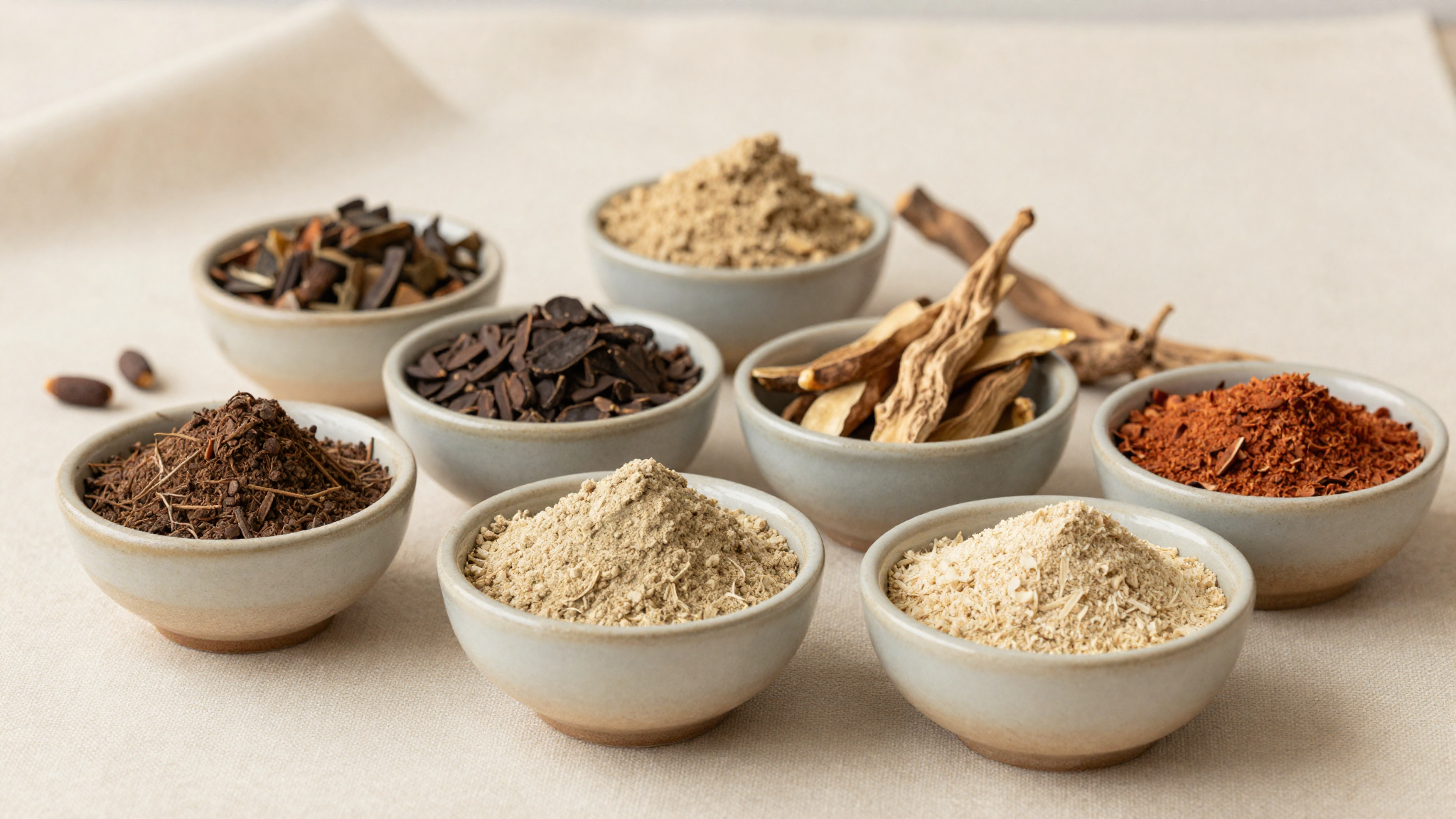
Adaptogens are a specific class of plants and fungi that support the body's natural stress-response system. They help maintain balance rather than forcing a single outcome. Popular examples include ashwagandha, rhodiola, and maca. Women use them to support steady energy, calm mood, and hormonal balance already within normal ranges.
What 'Adaptogen' Actually Means
The word adaptogen was coined in 1947 by a Soviet pharmacologist named Nikolai Lazarev. He was searching for substances that could help people perform better under sustained physical and mental stress. The term stuck. Today, herbalists and researchers use it to describe a specific category of plants and fungi that share three defining traits.
First: they are non-toxic at normal doses. Second: they produce a nonspecific response, meaning they support the whole system rather than one organ or one pathway. Third: they help the body maintain balance regardless of which direction the stress is pulling it. That third quality is the one that matters most.
A true adaptogen does not simply sedate you or stimulate you. It helps bring things back toward the middle. Think of it as a thermostat rather than a heater or an air conditioner. The thermostat does not pick a direction; it reads the room and adjusts.
Not every trendy herb qualifies. Lavender is calming but not an adaptogen. Caffeine is stimulating but not an adaptogen. Chamomile is soothing but does not meet the criteria. The classification is strict, which is why serious formulators are selective about what earns a spot in a product.
The Science Behind Your Stress Response
To understand why adaptogens matter, you need a quick look at the HPA axis. HPA stands for hypothalamic-pituitary-adrenal. This is the command chain your body uses when it perceives a threat, physical or psychological. The hypothalamus signals the pituitary gland. The pituitary signals the adrenal glands. The adrenals release cortisol and adrenaline into the bloodstream. The whole sequence takes seconds.
Short-term, this is exactly what should happen. Cortisol sharpens focus, mobilizes stored energy, and suppresses functions the body considers non-urgent during a crisis. The problem is that modern demands, work pressure, poor sleep, undereating, ongoing emotional stress, keep the signal running far longer than the system was designed to handle.
Chronically elevated cortisol can work against the things most women care about: steady energy through the afternoon, mood stability, restful sleep, and healthy body composition. It also influences hormonal systems downstream in ways that are not always obvious.
Adaptogens support the body's ability to regulate this axis. Research on ashwagandha root extract illustrates how specific compounds interact with stress-response pathways in ways that support a cortisol rhythm already within a normal range. The full mechanism is still being mapped, which is worth stating plainly. What consistent human studies do show: people using certain adaptogens regularly report feeling better under the same stressors, even when the stressor itself has not changed.
The Five Adaptogens Most Studied in Women
Not all adaptogens are equally well-studied in female populations. These five have the most credible human research behind them.
- Ashwagandha (Withania somnifera): The most studied adaptogen overall. The KSM-66 and Sensoril extracts appear in most of the serious clinical work. Studied doses range from 300 to 600 mg of root extract daily. Trials have examined its role in supporting cortisol levels already within a normal range, perceived energy, and sleep quality in healthy adults.
- Rhodiola rosea: A root from Siberia and Scandinavia, studied more for mental endurance and fatigue support than for hormonal concerns. The active compounds are rosavins and salidroside. Look for extracts standardized to at least 3% rosavins and 1% salidroside. Doses in research range from 200 to 680 mg daily.
- Maca (Lepidium meyenii): A Peruvian root vegetable, not a shrub or herb. Maca works differently from the others because it does not directly modulate cortisol. Research points to its role in supporting hormonal balance already within normal ranges, particularly in women in their late 30s and 40s. Gelatinized maca absorbs meaningfully better than raw powder.
- Shatavari (Asparagus racemosus): An Ayurvedic herb with centuries of documented use in women's wellness traditions. Human trials are smaller in scale than those for ashwagandha, but they support its role in maintaining reproductive-system vitality and comfort during hormonal transitions.
- Reishi mushroom (Ganoderma lucidum): Technically a fungus. Reishi is studied more for immune support and sleep quality than for direct stress modulation, but it complements other adaptogens well in blended formulas and has a long track record in traditional East Asian medicine.
Why Extract Quality and Format Matter
A capsule of raw ashwagandha root powder at 50 mg does almost nothing useful. The extract concentration and standardization are what separate a meaningful dose from a marketing checkbox.
Standardized extracts are the benchmark. "Standardized to 5% withanolides" means the manufacturer has tested and designed that 5% of the extract weight is that specific compound class. This is what allows researchers to design repeatable trials and what allows you to compare a product against published research.
Adaptogens now appear in tinctures, smoothie powders, gummies, functional chews, and cubes. Customers often ask us which format absorbs best. Our honest answer: standardized extract quality matters far more than delivery vehicle. A well-formulated chew using KSM-66 ashwagandha will outperform a sloppy capsule using ungraded root powder at nearly any dose.
What to check on any label:
- The extract name (KSM-66, Sensoril, Rhodiolife, and similar branded extracts signal that the manufacturer paid for a standardized, tested ingredient)
- The standardization percentage for the key compounds
- The milligram dose stated clearly, not buried in a proprietary blend
- A certificate of analysis available on request
Adaptogens and the Female Hormonal Cycle
The female hormonal cycle is not a flat line. Estrogen and progesterone rise and fall across a roughly 28-day window, and cortisol interacts with both throughout that span in ways that are not always obvious.
High cortisol can affect progesterone production because both hormones share a precursor molecule called pregnenolone. Under sustained stress, the body may shift pregnenolone toward cortisol synthesis. The result can be a subtle shift in the estrogen-to-progesterone ratio that shows up as fatigue, mood changes, or heightened premenstrual discomfort.
Adaptogens that support healthy cortisol regulation already within a normal range may, indirectly, support the downstream hormonal rhythm. Research in this specific direction is still developing, and the evidence is promising but not yet conclusive. We will not overstate it here. What women frequently tell us after 8 to 12 weeks of consistent use: the days before their period feel more manageable. Steadier energy. A mood that is easier to navigate. That is not a fix for any specific condition. It is a system functioning a little closer to its own equilibrium.
For a grounded overview of what current science says, the NCCIH page on ashwagandha is a solid starting point.
How to Build a Routine That Actually Works
Adaptogens are not like caffeine. You will not feel them the first morning. Most clinical trials that show meaningful results run for 8 to 12 consecutive weeks of daily use, and that timeline reflects how these herbs accumulate and work.
The most common mistake: quitting at two or three weeks, which is exactly when consistent accumulation is starting to matter. Consistency is the whole strategy here.
A few guidelines that hold across most adaptogens:
- Start with one or two, not six. Combination formulas can be well-designed, but if you are new to this category, a focused product lets you understand your own response before adding complexity.
- Time it to the cortisol awakening response. Cortisol peaks naturally 30 to 45 minutes after waking. Taking adaptogens in the morning, near that window, may support how they interact with your stress system. Morning is also easier to make a habit.
- Track the right signals. Afternoon energy dips, sleep quality, mood in the week before your period. These are where women most often notice changes. A simple daily note for 30 days is enough data to evaluate whether something is working.
The best adaptogen formula is the one you actually take every day. That outweighs almost every other variable.
What to Look for Before You Buy
The supplement market is lightly regulated compared to pharmaceuticals. That gap creates real variation in product quality, and the consumer carries most of the burden of sorting through it.
Three things worth verifying before any purchase:
- Third-party testing: A certificate of analysis from an independent lab confirms what is in the product and screens for heavy metals, pesticides, and microbial contamination. Brands that publish these proactively are telling you something. Brands that deflect the question are telling you something too.
- Named, standardized extracts: "Ashwagandha extract" on a label tells you almost nothing. "KSM-66 ashwagandha root extract, standardized to 5% withanolides, 300 mg" tells you exactly how to evaluate it against the clinical literature.
- Transparent individual dosing: Proprietary blends that hide milligram amounts make it impossible to know whether any ingredient reaches a meaningful dose. A product listing 500 mg total across ten ingredients may contain 450 mg of the cheapest filler and 5 mg of the active.
In our formula, we use named standardized extracts at clinically studied doses, not token amounts that let a brand check a marketing box. Try the Minx Cubes adaptogen blend if you want a daily format enjoyable enough to stick with and transparent enough to actually evaluate. That combination is harder to find than it should be.
Frequently asked questions
Are adaptogens safe to take every day long-term?
The most studied adaptogens, including ashwagandha, rhodiola, and maca, have well-established safety profiles at normal doses. Most human trials run 8 to 12 weeks without adverse effects in healthy adults. If you take prescription medications or have an existing health condition, check with your healthcare provider before adding any new supplement to your routine.
How long does it take to notice a difference?
Most clinical trials run 8 to 12 weeks before measuring outcomes, and that timeline reflects how these herbs work. Some women notice subtle changes in sleep quality or afternoon energy within two to three weeks. Meaningful support for stress resilience and mood typically builds with consistent daily use over a longer period. Give it a full 30 days of honest tracking before drawing conclusions.
What is the difference between ashwagandha and maca?
Ashwagandha works primarily through the HPA axis, supporting cortisol levels already within a normal range and promoting a sense of calm, steady energy. Maca is a food-like root vegetable that does not directly modulate cortisol. Research on maca focuses instead on supporting hormonal balance already within normal ranges and overall vitality, particularly for women in their late 30s and 40s. Both are well-studied and complement each other in a thoughtful formula.
Can I take adaptogens while pregnant or breastfeeding?
Research on adaptogen safety during pregnancy and breastfeeding is limited. Standard guidance is to avoid any supplement not specifically reviewed by your OB or midwife during these periods. This is not unique to adaptogens; it applies across most botanical products. When in doubt, wait and ask your provider.
Do adaptogens interact with hormonal birth control?
No well-documented interactions exist between the most studied adaptogens (ashwagandha, rhodiola, maca) and hormonal contraceptives at normal supplement doses. Individual responses vary, and it is always a good idea to mention any new supplement to your prescriber at your next visit.
These statements have not been evaluated by the Food and Drug Administration. This product is not intended to diagnose, treat, cure, or prevent any disease.
Written by The Minx Editorial, Women's Wellness Editor.
Read more
Wondering when to take your libido supplement? Our timing guide covers morning vs evening dosing, food pairing, and cycle syncing for consistent results.
Maca and ashwagandha both support energy and balance, but they work very differently. Find out which adaptogen fits your goals, taste, and daily routine.