
What to Look for in a Men's Intimacy Supplement
Look for individually listed ingredients with standardized extracts, not proprietary blends. Meaningful men's intimacy formulas typically include L-citrulline for blood flow support, saffron for mood, adaptogens like Panax ginseng for stress response, and botanicals like beetroot and mucuna pruriens.
The Label Is the Product
The bottle design, the brand story, the celebrity endorsement: none of it tells you whether a formula will do anything. The Supplement Facts panel does. And yet most buyers spend more time reading marketing copy than the actual ingredient list.
There are exactly three questions worth asking before committing to any men's intimacy supplement. What ingredients are in it? What forms and standardizations are those ingredients in? Are the individual amounts listed, or are they buried inside a proprietary blend?
A proprietary blend means the manufacturer can list five or six ingredients under one combined weight, say 350 mg total, without telling you how much of each is present. That format protects a recipe but leaves you guessing whether you are getting a meaningful amount of the ingredient that made you buy it in the first place.
Customers often ask us how to separate a well-formulated product from a cleverly packaged one. The answer starts with those three questions every time.
L-Citrulline and Beetroot: The Circulation Pair
Blood flow is foundational to male sexual function. Two ingredients in this category have earned genuine scientific attention: L-citrulline and beetroot.
L-citrulline is an amino acid the body converts first to L-arginine, then into nitric oxide. Nitric oxide signals smooth muscle tissue in blood vessel walls to relax, which supports healthy circulation already within a normal range. The reason L-citrulline outperforms direct L-arginine supplementation is straightforward: the digestive tract and liver break down oral L-arginine before it reaches circulation. L-citrulline bypasses that bottleneck.
Research indexed by the National Library of Medicine supports L-citrulline’s role in raising plasma arginine levels and promoting the nitric oxide pathway in healthy adult men.
On the label, look for L-citrulline as a standalone ingredient or L-citrulline malate. The malate form binds L-citrulline to malic acid for potentially better stability. Avoid vague listings like “citrulline complex” that do not specify the form.
Beetroot (Beta vulgaris) adds a second nitric oxide pathway. Dietary nitrates in beetroot are converted by bacteria in saliva to nitrite, then to nitric oxide. This mechanism is independent of the L-citrulline route, so the two can work together without overlap. Look for beetroot extract or whole beetroot powder rather than generic beet juice powder, which can vary significantly in nitrate concentration.
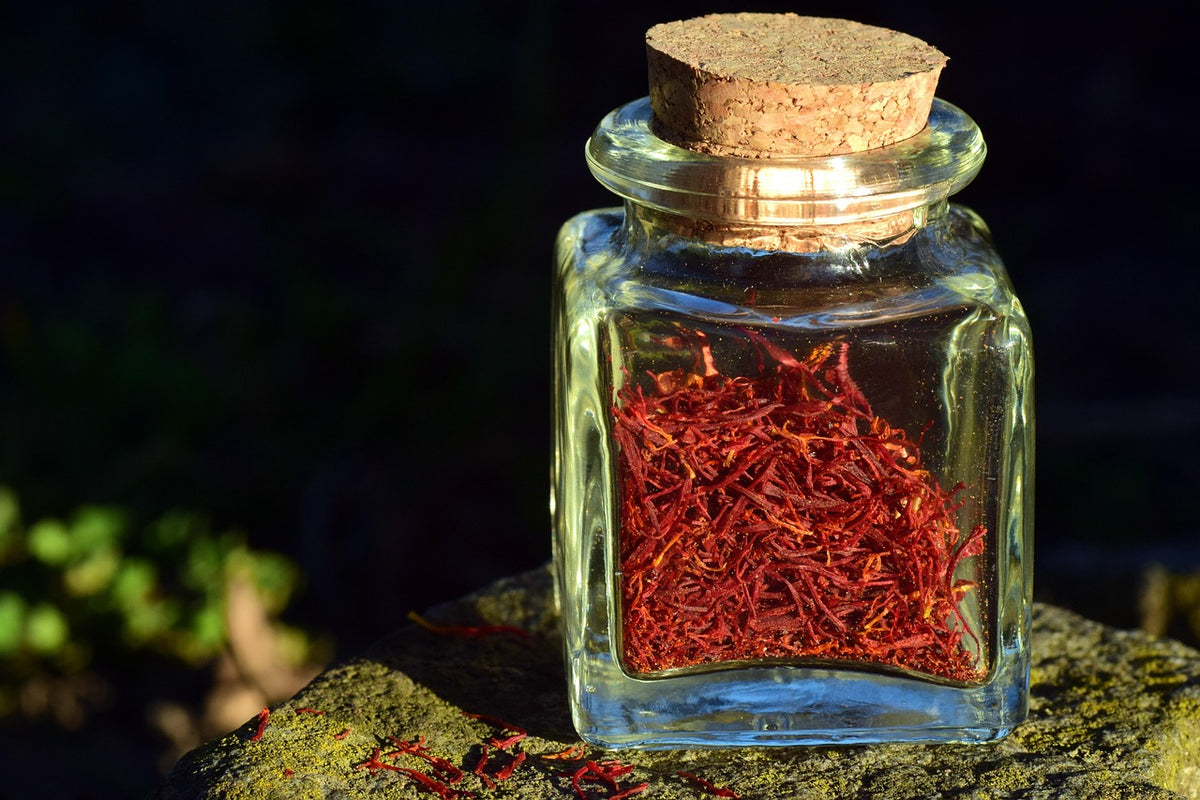
Saffron: More Than a Spice
Intimacy has a psychological dimension that blood flow alone cannot address. Stress, distracted thinking, and mood weight are among the most consistently reported barriers to desire. Saffron works in this space.
Crocus sativus, the plant that produces saffron, contains two primary active compounds: crocin and safranal. Both have been studied for their effects on serotonin metabolism. Serotonin plays a central role in mood regulation already within a normal range, and saffron’s ability to influence serotonin activity has been examined in multiple small trials.
The NIH Office of Dietary Supplements maintains ongoing evidence summaries on botanicals including saffron. The research base is modest but consistent enough to justify its place in a formula designed to support desire and emotional connection.
It is worth noting that saffron’s effects appear to work through different pathways than the nitric oxide-based ingredients. That complementary action is one reason formulas that include both saffron and L-citrulline address more of the picture than either ingredient alone.
Form matters here perhaps more than anywhere else. Saffron is expensive, which means many products include only a token amount of raw saffron powder. Look for saffron extract standardized to crocin content, typically listed as Crocus saffron extract standardized to a defined crocin percentage. An unstandardized powder tells you nothing about potency.
Mucuna Pruriens: The Dopamine Precursor
Dopamine drives motivation, reward, and the wanting dimension of desire. Mucuna pruriens, a leguminous plant used in Ayurvedic practice for centuries, contains L-DOPA, the direct biochemical precursor to dopamine. No extra conversion step is needed; the body moves L-DOPA toward dopamine efficiently.
Standardized mucuna extract is the form to look for. Whole seed powder contains variable and unpredictable amounts of L-DOPA. An extract standardized to a specific percentage, commonly 15% L-DOPA, gives you a consistent and interpretable profile. The label should specify the standardization clearly; a listing that simply says “mucuna pruriens powder” tells you very little.
One note on balance: because L-DOPA is genuinely bioactive, mucuna is not an ingredient where more is simply better. It should be part of a considered, balanced formula rather than the dominant ingredient by weight. If a label shows mucuna pruriens at the top of the list with no other significant botanicals alongside it, that warrants a closer look at what else is present.
Panax Ginseng: Why the Latin Name Matters
Ginseng is one of the most misused words in supplement marketing. The term gets applied to at least three plants with meaningfully different compound profiles.
Panax ginseng, also labeled Korean ginseng or Asian ginseng, is the species with the deepest research history for supporting vitality, stamina, and stress response. Its active compounds, ginsenosides, are specific to the Panax genus. American ginseng (Panax quinquefolius) has a different ginsenoside ratio and a different evidence profile. Siberian ginseng is not a Panax plant at all; it belongs to a separate botanical family with no ginsenosides.
The practical rule: if the label says “ginseng root” with no Latin name, you cannot tell which plant you are taking. Look for Panax ginseng with the full Latin name present and, ideally, an extract standardized to a ginsenoside percentage.
Adaptogens like Panax ginseng are thought to help the body maintain balance under both physical and mental stress. That is a distinct function from direct stimulation, and it makes ginseng a useful complement to the more targeted mechanisms of L-citrulline and mucuna pruriens in a well-rounded formula.
Fillers, Dyes, and the Other Ingredients List
The Other Ingredients section is easy to skip. It should not be.
Common processing aids include magnesium stearate, a flow agent added during capsule manufacturing; silicon dioxide, an anticaking agent; and titanium dioxide, a whitener. None are acutely harmful in trace amounts, but heavy use of them can signal that formula space was allocated to manufacturing convenience rather than active ingredients.
Artificial dyes, Red 40, Yellow 5, Blue 1, serve no nutritional purpose in a wellness product. They are inexpensive and widely used, but they contribute nothing functional to the formula. Their presence is worth noting.
If the product is a gummy or chewable, pay attention to the sweetener. Maltitol, a common sugar alcohol, can cause digestive discomfort at doses above a few grams. Erythritol and xylitol are generally better-tolerated alternatives. High added sugar in a gummy is a trade-off worth knowing about before you commit.
In our formula, the Other Ingredients list is kept short by design. Every item in it earns its place, and the active ingredient list comes first.
Five Checks Before You Buy
Pull up any product page and run through these checks:
- Named key ingredients: Does the label list L-citrulline, saffron extract, mucuna pruriens, Panax ginseng, and beetroot as distinct, individually identified items?
- Standardized forms: Are botanical extracts standardized to specific active compound percentages, or just listed as raw powders?
- Transparent dosing: Are individual ingredient amounts visible, or are several ingredients grouped under one combined proprietary blend weight?
- Clean filler list: Is the Other Ingredients section short, recognizable, and free of unnecessary dyes and sweeteners?
- Third-party verification: Does the brand show any independent testing, such as a Certificate of Analysis or a certification from NSF, USP, or a similar body?
A formula that passes all five of these checks is worth serious consideration. One that fails two or more is giving you real information about how it was built.
The team at our Minx wellness shop designed MINX MAN CUBES around these exact standards: transparent labeling, botanical forms that are specific and standardized, and an Other Ingredients list short enough to read in ten seconds. If you want to compare what you find in the market against a formula that made these choices deliberately, that is a clear starting point.
Frequently asked questions
What is the difference between L-citrulline and L-arginine in a supplement?
L-citrulline converts to L-arginine in the kidneys and raises blood arginine levels more reliably than oral L-arginine, because the gut and liver break down direct L-arginine before it reaches circulation. Supplements listing L-citrulline or L-citrulline malate generally deliver more consistent support for nitric oxide production and blood flow already within a normal range.
Does the form of saffron in a supplement actually matter?
Yes. Saffron extract standardized to a defined crocin or safranal percentage is more consistent and interpretable than raw saffron powder. Since saffron is expensive, some products include only a trace amount of unstandardized powder with no meaningful active compound level. Look for the Latin name Crocus sativus and a standardization percentage clearly stated on the label.
Why does the species of ginseng matter on a supplement label?
Panax ginseng, American ginseng, and Siberian ginseng are three different plants with different active compounds. Only Panax ginseng contains ginsenosides, the compounds most studied for supporting vitality and stress response already within a normal range. A label that says only ginseng root without a Latin name does not tell you which plant you are taking.
What is a proprietary blend and why should I be cautious of it?
A proprietary blend groups multiple ingredients under one combined weight, such as 450 mg herbal complex. This format protects a manufacturer's recipe, but it means you cannot see how much of each ingredient is present individually. If a key ingredient is listed last in a long blend, it may exist in only a trace amount with no practical effect on the body.
Can beetroot and L-citrulline be taken together in the same formula?
Yes, and they complement each other well. L-citrulline works through the enzyme-driven L-arginine to nitric oxide pathway, while dietary nitrates from beetroot use a separate saliva-dependent bacterial conversion route. Because the mechanisms are distinct, both ingredients can contribute to supporting healthy circulation already within a normal range without competing with each other.
These statements have not been evaluated by the Food and Drug Administration. This product is not intended to diagnose, treat, cure, or prevent any disease.
Written by The Minx Editorial, Women's Wellness Editor.
Read more
Poor sleep, muscle tension, and mood shifts may signal that your body wants more magnesium. Learn the signs and explore support for intimate wellness.
Zinc supports testosterone synthesis and sperm integrity in men. Learn how dietary gaps affect vitality and what to do about it. Explore wellness at Minx.