
Shatavari: The Ayurvedic Herb Women Are Discovering
Shatavari (Asparagus racemosus) is a climbing plant native to India and the Himalayas, used in Ayurvedic medicine for thousands of years as a tonic herb for women. Modern herbalists and researchers study it for its potential to support hormonal comfort, adrenal balance, and overall vitality through its naturally occurring steroidal saponins.
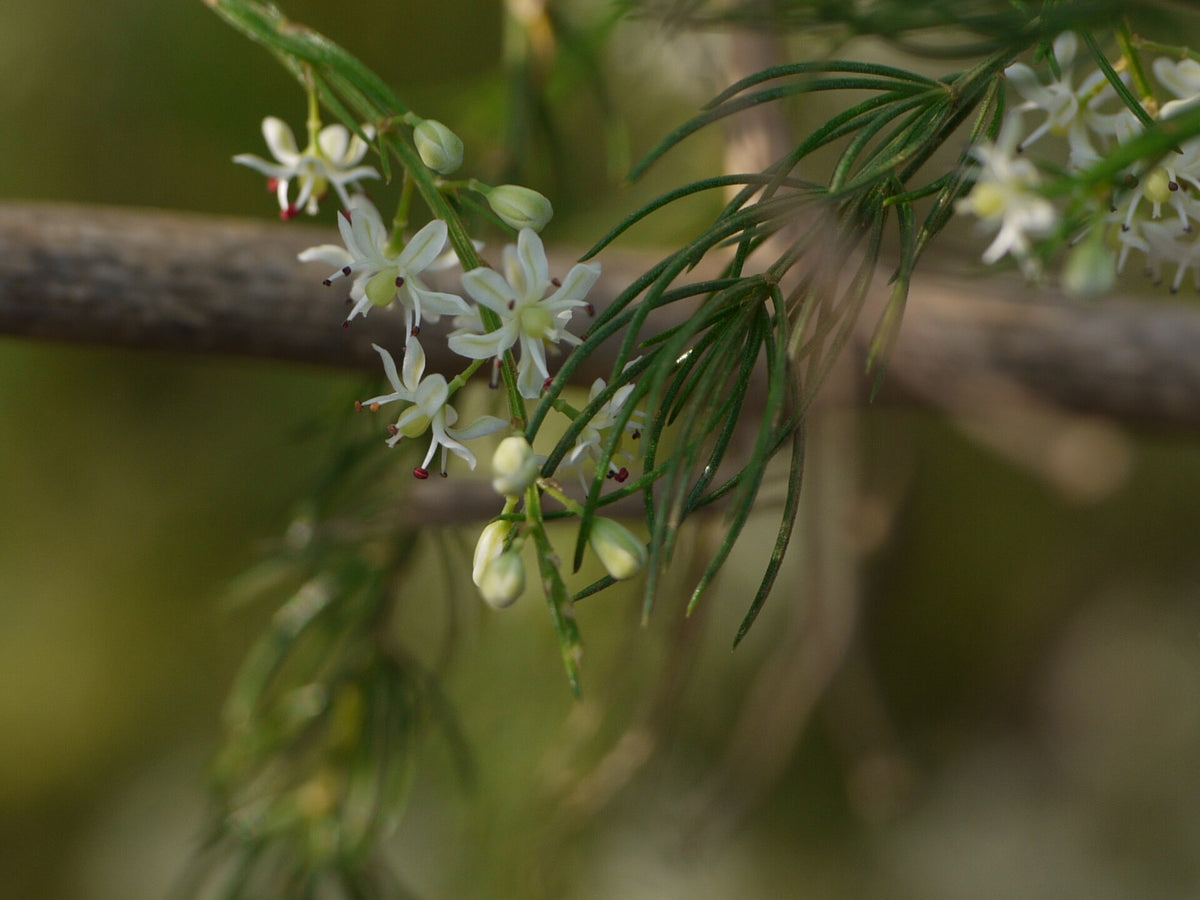
Dinesh Valke from Thane, India / CC BY-SA 2.0 / via Wikimedia Commons
The Plant Behind the Name
The name alone carries weight. Shatavari translates from Sanskrit, roughly, as "she who possesses a hundred husbands," a poetic gesture toward the plant's ancient reputation as a restorative tonic for women. The name is evocative, not literal. What it signals is longevity, abundance, and the sustained vitality that Ayurvedic physicians associated with this herb for over three thousand years.
Botanically, shatavari is Asparagus racemosus, a climbing shrub that grows across the foothills of the Himalayas, through the forests of India and Sri Lanka, and into parts of Africa. It produces soft, feathery leaves and small white flowers. The part used in herbal medicine is the root system, a dense cluster of tuberous roots that can reach several feet in length and carry a distinctly bitter, resinous flavor.
Shatavari belongs to the same botanical family as the asparagus you find in grocery stores. The roots are far more potent. Harvesters in Ayurvedic tradition have collected, dried, and powdered them for centuries, incorporating them into formulas intended to restore and nourish the female body at every life stage.
This is not a trend. Shatavari appears in the Charaka Samhita and the Sushruta Samhita, two of the oldest surviving medical texts in the world. That kind of record is rare. It earns the herb serious attention.
Shatavari's Place in Ayurvedic Medicine
In Ayurveda, herbs are classified not just by what they do, but by their energetic qualities: their taste, their heating or cooling effect on the body, and the tissues they nourish. Shatavari is considered cooling and sweet, with a slight bitter edge. Ayurvedic texts place it among the rasayanas, a category of herbs and preparations used to support the body's long-term vitality and natural renewal.
For women specifically, shatavari was associated with the "shukra dhatu," the reproductive tissue in Ayurvedic physiology. Practitioners prescribed it to support women across multiple life stages. Young women experiencing difficult monthly cycles. Women in their thirties and forties navigating early hormonal shifts. Older women seeking to maintain their energy and comfort in the postmenopausal years.
It was rarely used alone. Classic formulas combined shatavari with warming roots like ashwagandha to balance its cool nature, or with amalaki, a potent antioxidant fruit, to build a complete restorative blend. The tradition of pairing complementary botanicals for synergistic effect is thousands of years old.
What sets shatavari apart from other Ayurvedic herbs is its specificity to the female system. Ayurvedic texts are clear on this point. It was not a general tonic used interchangeably for men and women. It was formulated for the female body, with detailed guidance on preparation methods and appropriate life stages. That precision is part of why modern researchers decided to look more closely.
What the Science Is Beginning to Show
When phytochemists first analyzed shatavari root, they found a group of steroidal saponins called shatavarins. Shatavarin IV has received the most research attention. These compounds share structural similarities with estrogens, which is why researchers classify shatavari as a phytoestrogenic herb.
Research indexed on PubMed has explored Asparagus racemosus extracts in relation to female hormonal markers already within a normal range. Several preclinical and clinical studies suggest the saponin fraction may help support the body's natural estrogen-like signaling during periods of hormonal change. Results are preliminary. The pattern, though, is consistent enough to sustain continued investigation.
Beyond the saponins, shatavari root contains isoflavones, polyphenols, and a mucilage fraction that may support the body's natural inflammatory response already within normal parameters. Some researchers are examining its potential effect on the HPA axis, the hormonal pathway connecting brain signaling to adrenal output and stress response.
One practical note: dosing matters. Most clinical studies have used standardized extracts ranging from 500 mg to 1,500 mg of root equivalent per day. Plain root powder and standardized extracts are not the same product. A standardized extract, typically specified at 10 to 20 percent shatavarin content, delivers more predictable potency and is the form used in published trials. That distinction is worth understanding before you buy.
Shatavari Across Women's Life Stages
Customers often ask us how adaptogenic herbs map onto the hormonal shifts that arrive with each decade of a woman's life. Shatavari comes up more than most. The reason is that it seems to accompany women through the full arc of reproductive life, rather than addressing a single phase.
In the reproductive years, shatavari's phytoestrogenic compounds may help support hormonal balance already within a normal range throughout the menstrual cycle. Several studies have examined its potential to promote greater ease during the luteal phase, the second half of the cycle, when progesterone rises and some women experience premenstrual discomfort. The research is still small-scale. The pattern, however, appears consistently across multiple studies.
For women in their forties navigating perimenopause, shatavari's potential to support estrogen-like activity already within a normal range becomes particularly relevant. Fluctuating estrogen levels affect mood, sleep rhythms, and overall comfort. Clinical trials on shatavari extract have measured outcomes like emotional steadiness and vitality during this transition, with generally positive findings and no significant adverse effects in healthy adult women.
Postmenopause, the conversation shifts toward sustained energy, bone comfort, and cardiovascular resilience. Shatavari's antioxidant and adaptogenic properties may help promote general vitality here, though longer-term clinical data is still developing.
Whatever the stage, shatavari works slowly. Most adaptogens require consistent daily use for four to eight weeks before effects become noticeable. It is a nourishing herb. Not an acute one.
Forms, Quality, and What to Look For
Not all shatavari products are equal. Sourcing and processing make a real difference with this herb.
The traditional form is root powder, sometimes blended with warm milk and honey in a preparation Ayurveda calls shatavari milk. Fat aids absorption, which is part of why the milk preparation makes sense. For convenience, capsules filled with root powder work well. For the most clinical relevance, a standardized extract is the stronger choice.
When evaluating any shatavari product, a few things are worth checking:
- Third-party testing for heavy metals. Roots grown in parts of South Asia can concentrate soil contaminants, and testing standards vary widely by brand.
- Standardization percentage, if you are using an extract. A benchmark of 10 to 20 percent shatavarin content aligns with the doses studied in clinical trials.
- Organic certification when possible. Conventionally grown roots may carry pesticide residue that concentrates in root tissue.
- Transparent labeling. The actual mg per serving and extract ratio should appear on the label, not obscured behind a proprietary blend designation.
One safety note: shatavari is generally considered safe for most adult women. It is, however, a phytoestrogenic herb. Women who are pregnant, nursing, or managing an estrogen-sensitive condition should speak with a healthcare provider before using it. Anyone taking hormonal medications should do the same.
Shatavari in a Broader Botanical Wellness Routine
Shatavari rarely works in isolation, and in traditional practice it was never intended to. Ayurveda built its most effective formulas by pairing complementary botanicals, each supporting a slightly different physiological pathway.
The modern equivalent of this thinking is the adaptogen stack. Women interested in whole-body support are increasingly pairing shatavari with herbs like ashwagandha for cortisol balance, maca for energy, or saffron for mood. Saffron, in particular, has built a strong research profile over the past decade. The National Center for Complementary and Integrative Health maintains a detailed fact sheet on saffron's studied effects on mood already within a normal range, and the citations are worth reading.
Mucuna pruriens is another botanical gaining attention. It contains naturally occurring L-DOPA, a precursor to dopamine, and has been studied for its potential to support dopamine pathway activity. Panax ginseng, one of the most rigorously researched adaptogens on the planet, has decades of evidence behind its effects on energy and resilience in women.
The team at the Minx wellness shop takes exactly this multi-botanical philosophy with the MINX CUBES formula, combining saffron, mucuna, and Panax ginseng alongside other naturally derived ingredients in a once-daily gummy. Each ingredient was selected for a specific biological mechanism. Together, they address multiple aspects of women's vitality and intimate wellness rather than targeting a single pathway in isolation.
If shatavari has caught your attention, it likely signals that your interest in botanical wellness is deepening. That curiosity tends to expand naturally into other herbs, other traditions, and other formulas designed with the same specificity.
Frequently asked questions
What is shatavari traditionally used for in Ayurvedic medicine?
In Ayurvedic tradition, shatavari is classified as a rasayana, a rejuvenating tonic, with a specific affinity for the female reproductive system. It has been used to support women's vitality, hormonal comfort, and overall nourishment across multiple life stages, from the reproductive years through the postmenopausal transition.
Is shatavari safe to take every day?
Shatavari has a long history of daily use in Ayurvedic practice and is generally considered safe for healthy adult women. Most clinical studies have used it daily for periods of four to twelve weeks without significant adverse effects. Women who are pregnant, nursing, or managing an estrogen-sensitive condition should speak with a healthcare provider before use.
How long before shatavari has a noticeable effect?
Shatavari is an adaptogenic herb, meaning it works cumulatively rather than acutely. Most practitioners and researchers suggest consistent daily use for at least four to eight weeks to support noticeable shifts in hormonal comfort and vitality. Significant effects after a single dose are unlikely.
Can shatavari support hormonal comfort during perimenopause?
Shatavari contains steroidal saponins that may support estrogen-like activity already within a normal range, which is one reason it has attracted research attention for women navigating perimenopause. Small clinical trials have reported improvements in vitality and emotional steadiness. It is not a replacement for medical care, and individual results vary.
What is the difference between shatavari root powder and a standardized extract?
Root powder is the whole dried root ground fine. A standardized extract is concentrated and tested to contain a specific percentage of active saponins, typically 10 to 20 percent shatavarin content. Most published clinical studies use standardized extracts, which deliver more consistent potency than plain root powder at an equivalent serving size.
These statements have not been evaluated by the Food and Drug Administration. This product is not intended to diagnose, treat, cure, or prevent any disease.
Written by The Minx Editorial, Women's Wellness Editor.
Read more

Morning or evening? Food or fasted? Here's what absorption science says about timing intimacy supplements for consistent, noticeable support.
High cortisol quietly competes with desire hormones at the cellular level. Learn how the HPA axis works and which botanicals help support healthy balance.