
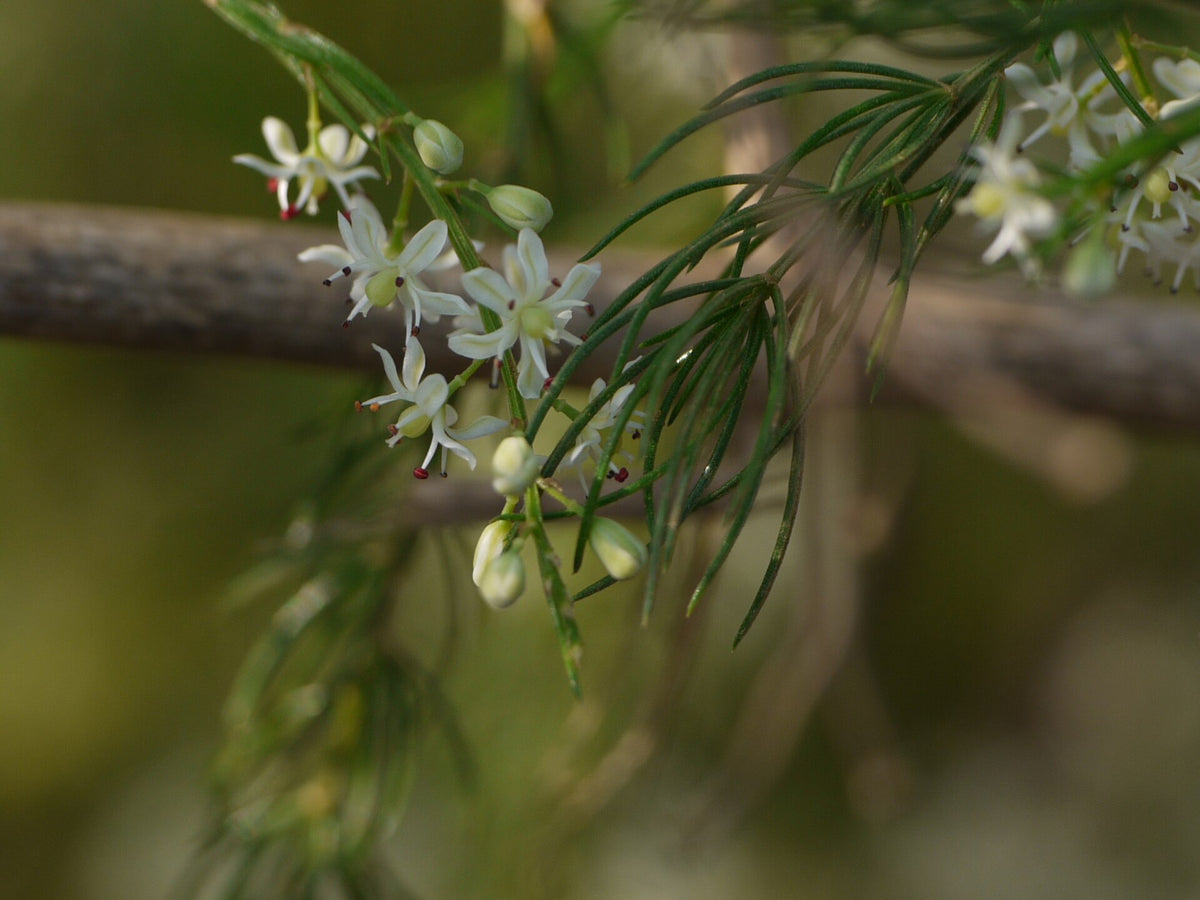
Shatavari: The Ayurvedic Herb for Women's Balance
Shatavari (Asparagus racemosus) is a root used in Ayurvedic medicine for over 2,000 years to support hormonal comfort in women. Its steroidal saponins have mild phytoestrogenic activity that may help the body maintain balance across the menstrual cycle and during perimenopause.
Dinesh Valke from Thane, India / CC BY-SA 2.0 / via Wikimedia Commons
What Is Shatavari?
Asparagus racemosus. The name sounds clinical, but women across India and Southeast Asia have been reaching for this climbing vine for at least 2,000 years. In Sanskrit, shatavari loosely translates to "she who possesses 100 husbands," a nod to the vitality and resilience this plant was believed to offer at every stage of a woman's life.
The root is where the action is. Shatavari produces thick, tuberous roots, sometimes 30 or 40 from a single plant, packed with the compounds Ayurvedic practitioners prized most. Ancient texts classified it as a rasayana, a category of herbs meant to promote longevity, strength, and overall balance rather than address any single complaint.
It was traditionally used for girls entering puberty, for mothers after childbirth, and for women navigating the transition out of their reproductive years. That lifespan perspective is one reason modern researchers find it interesting: if a single plant traditionally served women at three such different hormonal stages, something in its chemistry is probably doing work across the endocrine system broadly.
The Phytochemistry That Matters
Shatavari's most studied compounds are steroidal saponins called shatvarins, particularly shatavarin I through IV. Saponins are a broad class of plant chemicals, but the shatavarin group has structural similarities to human steroid hormones. That structural resemblance is thought to be why shatavari can interact gently with estrogen receptors without behaving like a synthetic hormone.
Beyond saponins, the root contains:
- Isoflavones and flavonoids, including quercetin and rutin, which support antioxidant activity in tissues
- Polysaccharides that appear to support immune cell activity in preliminary research
- Racemosol, a stilbenoid unique to this species
- Alkaloids, including asparagamine A
The combination matters more than any single molecule. Whole-root and standardized root extracts tend to perform differently in studies than isolated shatvarins, which suggests the plant works as a system. A 2018 review in the Journal of Ethnopharmacology noted that the full phytochemical profile of Asparagus racemosus appears to contribute to its observed effects on hormone-related comfort, though researchers continue to map the exact mechanisms.
Shatavari and the Menstrual Cycle
The menstrual cycle is driven by estrogen and progesterone rising and falling in a specific rhythm. When that rhythm runs smoothly, most women feel relatively steady. When it doesn't, the luteal phase, the two weeks before menstruation, can bring physical and mood-related discomfort that ranges from mild to disruptive.
Shatavari appears to support the body's ability to maintain that rhythm. The shatvarins bind loosely to estrogen receptors, offering what researchers sometimes call a phytoestrogenic effect: gentle activity that doesn't override the body's own signaling but may help buffer the estrogen drop that occurs in the late luteal phase.
Customers often ask us whether shatavari works like hormone replacement. It doesn't. The binding affinity of shatvarins is far weaker than that of estradiol, the body's primary estrogen. Think of it more as background support, helping the body maintain comfort levels already within a normal range rather than pushing any particular hormonal state.
One small clinical study tracked women taking 500 mg of shatavari root extract twice daily for three cycles. Participants reported improved scores on comfort and mood questionnaires during the luteal phase compared to baseline, though the study size was limited and larger trials are still needed.
The Perimenopause Years
Perimenopause starts, on average, around age 45. For many women, subtle shifts begin in the early 40s. Estrogen production becomes irregular. Cycles may shorten or lengthen unpredictably. Sleep can feel lighter. Temperature regulation gets less reliable.
This is exactly the territory Ayurvedic practitioners were describing when they recommended shatavari for women in midlife. The herb was not positioned as a supports for anything. It was positioned as support for a body in transition.
Several small clinical trials have found that women supplementing with standardized shatavari extract reported improvements in comfort and well-being scores during the perimenopausal transition compared to baseline, with no serious adverse events documented over the study periods. Researchers point to the phytoestrogenic activity of shatvarins as a likely mechanism for helping maintain comfort in estrogen-sensitive tissues already within a normal range.
Eight to twelve weeks seems to be the window where most participants in these studies noticed a meaningful shift, which aligns with how long the herb has traditionally been prescribed before reassessing.
Forms, Dosing, and Quality
Shatavari is sold as raw dried powder, concentrated root extract, and liquid extract. The distinctions matter.
Raw powder is the most traditional form and the least expensive, but it delivers highly variable amounts of active shatvarins depending on where and when the plant was harvested. A 1,000 mg capsule of raw powder might contain 5 mg of shatvarins or 25 mg, and there is no way to know from the label unless the product is standardized.
Standardized extract means the manufacturer has tested and designed a specific saponin percentage. Most quality products standardize to 5% or 10% shatvarins by weight. An extract standardized to 5% at 500 mg delivers 25 mg of shatvarins, a meaningful, trackable dose.
Dosing in research ranges from 500 mg to 1,000 mg of standardized extract per day, usually split across two servings. Some traditional protocols call for higher amounts of raw powder, 3 to 6 grams daily, but this doesn't translate cleanly to extract dosing.
Look for shatavari sourced from India, the plant's native range, and certified organic when possible. Heavy metal testing is non-negotiable with roots. Shatavari accumulates soil compounds, and root-based supplements from non-tested sources have shown contamination in independent laboratory analyses.
How Minx Approaches the Formula
In our formula, shatavari works alongside complementary botanicals rather than standing alone. That's a deliberate choice. Traditional Ayurvedic preparations rarely used a single herb in isolation. Combinations were designed so that each plant's action reinforced or modulated the others.
Pairing shatavari with adaptogens like ashwagandha, for instance, addresses both the phytoestrogenic support and the HPA-axis regulation that stress research suggests matters for cycle regularity. Adding maca brings a complementary phytochemical profile with its own long history in women's wellness.
If you're curious how these ingredients work together, the Minx Cubes daily blend breaks it all down. The format, a chewable cube rather than a capsule, was designed for consistent daily use, because shatavari's effects appear to build over four to eight weeks of regular supplementation rather than being felt acutely after a single dose.
What the Research Says, Honestly
Shatavari has a strong traditional record and a growing body of modern research. Here's where the science actually stands.
Most human trials are small. Sample sizes of 20 to 60 women are common. Study periods are often short, eight to twelve weeks. Outcome measures rely heavily on self-reported questionnaires rather than hormone assays. This doesn't make the research worthless; it makes it preliminary.
Animal studies are more extensive and show interesting effects on reproductive hormone levels, uterine tissue, and lactation support in rodent models. How well those findings translate to humans is a question researchers are still working through.
Shatavari is one of the better-studied Ayurvedic herbs for women's wellness. The safety profile in human trials is consistently reassuring. The traditional evidence spans millennia. No herb is a silver bullet. But as part of a consistent wellness routine that includes quality sleep, stress management, and a nutrient-rich diet, shatavari is a reasonable addition with both historical depth and emerging scientific support behind it.
Frequently asked questions
How long does shatavari take to work?
Most studies reporting positive outcomes run for eight to twelve weeks. Shatavari's phytoestrogenic compounds appear to work gradually, supporting the body's hormonal comfort over time rather than producing immediate effects. Consistency over four to eight weeks is generally recommended before evaluating results.
Is shatavari safe to take every day?
Human clinical trials lasting up to three months have consistently reported no serious adverse events with daily shatavari supplementation. As with any botanical, it's reasonable to consult a healthcare provider before starting, especially if you are pregnant, nursing, or currently taking medication for a health condition.
Does shatavari raise estrogen levels?
Shatavari contains phytoestrogens, plant compounds with mild estrogen-like activity, but it does not raise your body's own estrogen production. The shatvarins bind weakly to estrogen receptors, which is quite different from synthetic estrogen therapy. Research suggests it helps support estrogen-sensitive tissues already within a normal range rather than pushing hormone levels higher.
What is the difference between shatavari powder and shatavari extract?
Raw powder is ground dried root with variable saponin content depending on the harvest. Standardized extract concentrates and designed the amount of active shatvarins per serving, typically expressed as a percentage, most often 5% or 10%. For predictable, research-aligned dosing, standardized extract is the preferable form.
Can shatavari be taken alongside ashwagandha or maca?
Yes. Traditional Ayurvedic formulations routinely combined shatavari with other adaptogens and tonics. Modern formulas often pair it with ashwagandha for HPA-axis support and maca for complementary phytochemical coverage. No adverse herb-herb interactions have been reported in clinical literature for these common combinations.
These statements have not been evaluated by the Food and Drug Administration. This product is not intended to diagnose, treat, cure, or prevent any disease.
Written by The Minx Editorial, Women's Wellness Editor.
Read more

A step-by-step evening ritual pairing supplement timing, warm lighting, and breathwork to support your intimate wellness. Shop MINX CUBES to begin tonight.
Black and red maca work differently for male vitality. Research shows what each does for drive, stamina, and sperm health. Explore the formula.