
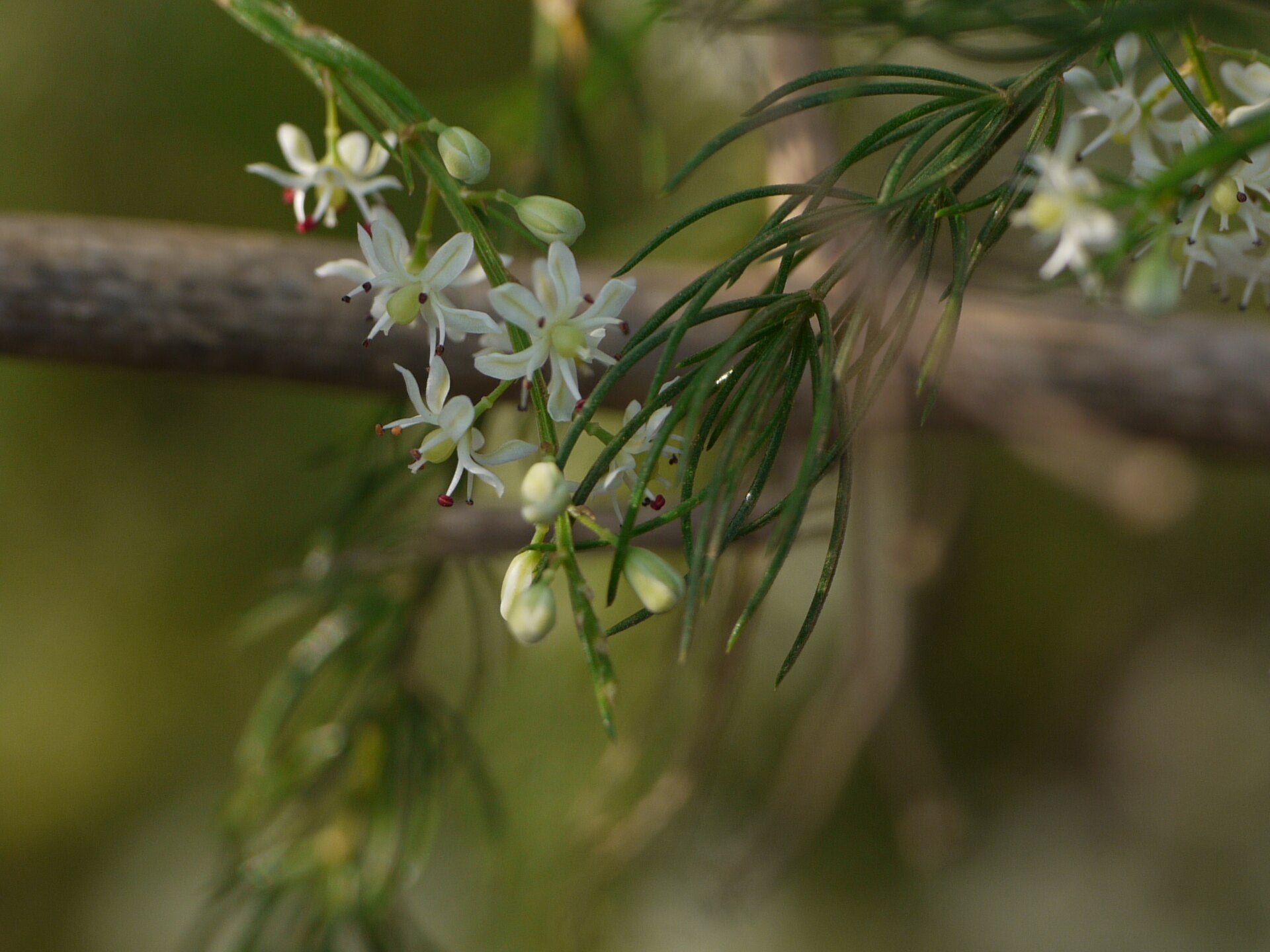
Shatavari: The Ayurvedic Herb for Women's Vitality
Shatavari (Asparagus racemosus) is a root used in Ayurvedic medicine for thousands of years to support female vitality and hormonal balance. Modern research suggests its active saponins help maintain healthy estrogen activity and support the body's natural adaptive response to everyday stress.
Dinesh Valke from Thane, India / CC BY-SA 2.0 / via Wikimedia Commons
A Root With a 5,000-Year History
Shatavari (Asparagus racemosus) belongs to the asparagus family, though it looks nothing like the vegetable on your plate. Its thin, pine-needle-like leaves sit atop a cluster of tuberous roots that Ayurvedic practitioners have harvested across India and the Himalayas for millennia. Classical texts such as the Charaka Samhita list it as a primary rasayana herb, a category of tonics prized for supporting vitality and longevity across the full arc of a woman's life.
The Sanskrit name translates roughly to "she who possesses a hundred husbands." Ancient physicians understood this as a metaphor for the herb's wide-ranging support for female physiology. Not one body system. Many.
Traditional preparations included shatavari ghee, milk infusions, and churna powders. Women were given these preparations across life stages: during adolescence, the reproductive years, and the decades beyond. That kind of multi-generational, cross-cultural consistency is rare in botanical medicine. It suggests the plant earned its reputation the slow way, through observation across thousands of individual lives, not a single controlled trial.
The Active Compounds That Drive the Research
Shatavari's effects come primarily from a group of steroidal saponins called shatavarins, labeled I through IV. Shatavarin I and IV have received the most scientific attention. They are structurally similar to certain estrogen precursors, which is why researchers studying plant-based hormonal support keep returning to this root.
Beyond shatavarins, the root contains a meaningful range of supporting compounds:
- Isoflavones, including formononetin and quercetin
- Polysaccharides that support immune activity
- Mucilage compounds associated with soothing and moisturizing properties
- Vitamins A, C, B1, and B2, alongside calcium and zinc
Research indexed at the National Library of Medicine has documented consistent patterns of adaptogenic, antioxidant, and hormone-modulating behavior across cell and animal studies. Human clinical trials are still catching up to the traditional evidence base, but the pharmacological picture is becoming clearer every decade. The compounds are real. The mechanisms are being mapped.
Shatavari and Hormonal Balance
One of the most studied areas is how shatavari interacts with the body's hormonal environment. The phytoestrogens in shatavari are not estrogen. They are plant compounds that bind to estrogen receptors with much lower potency than the body's own endogenous estrogen. That gentleness is part of the design.
When estrogen levels are already within a normal range, these phytoestrogens have minimal effect on receptor activity. When levels are fluctuating, they may help support balance by occupying receptors without overstimulating them. It is nuanced physiology, and shatavari has been part of that conversation in Ayurveda for centuries before Western science had language for it.
The cyclical nature of female hormones means small disruptions can compound quickly. One rough week can stretch into two. Shatavari's traditional use addressed this by giving the body a steady daily resource to draw from, rather than trying to correct imbalance after it appears. Customers often ask us whether shatavari is relevant only for perimenopause. It isn't. Women in their twenties and thirties use it to help maintain consistent energy and mood stability across their full cycle, and early adoption tends to make the later transitions smoother.
Intimate Wellness and What Shatavari Actually Does
Shatavari has a long traditional association with female reproductive and intimate wellness. The mucilage compounds in the root are thought to support natural moisture and lubrication throughout the body's mucous membranes. This is not metaphor. The plant contains mucilaginous tissue that Ayurvedic physicians specifically connected to vaginal tissue health, and that connection is one of the reasons the herb has remained central to women's wellness traditions for so long.
Modern integrative practitioners recommend it for women noticing changes in intimate comfort, particularly those whose hormonal levels are shifting. The mechanism is indirect: by helping the body maintain its own hormonal environment already within a normal range, shatavari supports the tissues that depend on that environment. Healthy estrogen signaling supports vaginal tissue integrity. Shatavari helps support healthy estrogen signaling. The logic follows.
Intimate dryness is common, underreported, and affects quality of life in ways that deserve a real conversation. An herb that helps the body support its own natural moisture pathways is worth understanding. That is exactly why we chose to include shatavari in our formula. You will find it inside the Minx Cubes intimate wellness supplement, paired with complementary ingredients chosen for the same purpose.
The Adaptogen Angle: Stress, Hormones, and Why the Connection Matters
Shatavari is also classified as an adaptogen, a term that gets applied loosely but carries a specific meaning: a substance that helps the body maintain internal stability under varying conditions. Adaptogens do not suppress the stress response. They help calibrate it.
For women, everyday stress has a direct physiological relationship with hormonal fluctuation. Cortisol and reproductive hormones share biochemical precursors. When the body prioritizes cortisol production under sustained stress, it draws from the same raw material pool that reproductive hormones depend on. Shatavari's saponins appear to support HPA axis function already within a normal range, helping the body allocate those resources more evenly rather than diverting everything toward cortisol.
The National Center for Complementary and Integrative Health notes that adaptogenic botanicals represent one of the most active areas of women's integrative health research. Shatavari sits alongside ashwagandha and rhodiola in that space, though its specific orientation toward the female reproductive axis gives it a different emphasis. Ashwagandha tends toward general stress resilience. Shatavari tends toward the female hormonal system specifically.
Consistent daily use over eight to twelve weeks is where most people notice the cumulative difference: more even energy across the day, steadier mood in the week before a period, and better sleep quality during high-stress phases. None of that happens from a single dose. It is a practice, not a quick fix.
Forms, Dosing, and What to Look for on a Label
Shatavari comes in several forms. They are not all equivalent, and the difference matters when you are trying to build a consistent daily habit.
- Root powder (churna): Traditional and affordable. Mix 3 to 6 grams into warm liquid daily. Potency varies considerably by source and handling.
- Standardized extract (10:1 or 20:1 ratio): Concentrated for declared saponin content. Typical dose is 250 to 500 mg daily. More consistent than raw powder.
- Tincture: Alcohol-based extraction with fast absorption. Easy to dose, but potency varies widely between brands and batches.
- Functional formats (gummies, cubes, chews): Growing in popularity because daily compliance improves when the format is genuinely enjoyable to take.
When reading a label, look for Asparagus racemosus listed by its Latin binomial and a declared extract ratio or percentage of shatavarins. Vague proprietary blends without disclosed amounts make it impossible to know what you are actually taking. A brand that won't tell you how much of the active compound is in each serving is a brand worth skipping.
One practical note worth repeating: shatavari builds cumulatively. It is not a spot treatment. Both traditional Ayurvedic guidance and modern adaptogen research point to consistent daily use over weeks as the mechanism that matters. Build the habit first, then assess at the 60-day mark. The women who get the most from it supports it like a daily practice, not a one-time experiment.
Frequently asked questions
Is shatavari safe to take every day?
Shatavari is generally well tolerated as a daily supplement, with centuries of continuous use in Ayurvedic practice across diverse populations. If you are pregnant, nursing, or taking hormonal medications, speak with your healthcare provider before adding any new herb or supplement to your routine.
How long does it take to feel results from shatavari?
Most people report noticing differences in energy, mood, and cycle consistency between four and twelve weeks of daily use. Adaptogens build cumulatively, so regularity matters more than the exact dose on any given day. The 60-day mark is a practical checkpoint for a fair assessment.
Does shatavari affect estrogen levels?
Shatavari contains phytoestrogens, plant compounds that interact gently with estrogen receptors. They help support hormonal balance already within a normal range. They are not pharmaceutical estrogen and do not produce the same potency of receptor stimulation, which is what makes them suitable for long-term daily use.
Can shatavari support vaginal dryness?
Shatavari is traditionally used to support natural moisture and intimate comfort. Its mucilaginous compounds and phytoestrogen content may help maintain tissue health in women whose hormonal levels are shifting. It supports the body's own pathways and should complement, not replace, professional care for persistent concerns.
What does shatavari taste like?
The raw root powder is mildly sweet with a slightly bitter, earthy undertone. Traditional Ayurvedic preparations blend it into warm milk with honey to soften the flavor. Functional formats like cubes or gummies mask the raw taste entirely, which is a real advantage for building a daily habit without dread.
These statements have not been evaluated by the Food and Drug Administration. This product is not intended to diagnose, treat, cure, or prevent any disease.
Written by The Minx Editorial, Women's Wellness Editor.
Read more
Fenugreek isn't just a men's herb. Learn 5 things every woman should know about fenugreek, hormonal balance, libido support, and finding the right formula.
Cortisol and intimacy are closely linked. Spot four body signals suggesting stress may be dulling your desire, and learn how to support your body naturally.